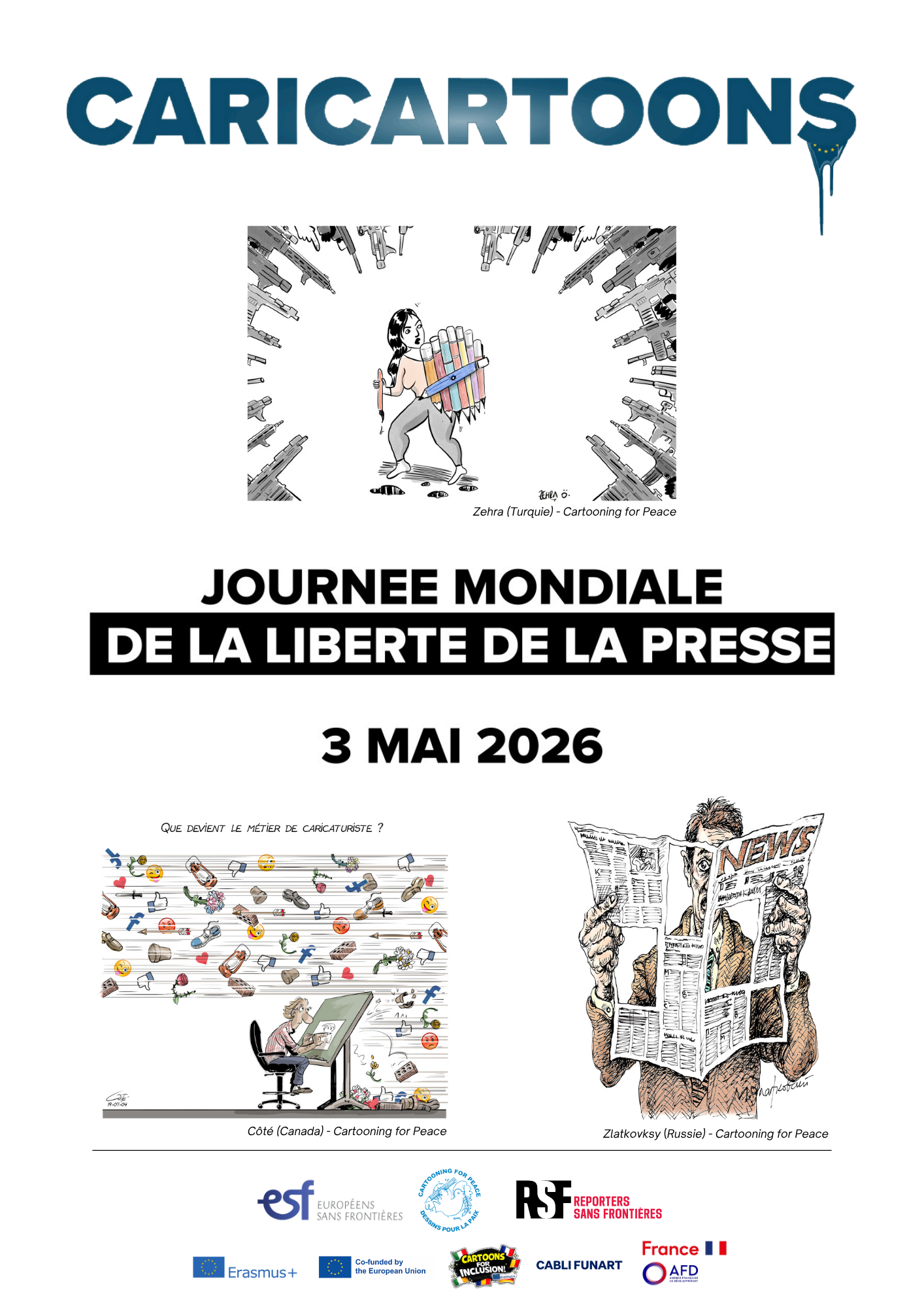
To mark World Press Freedom Day on May 3, Europeans Without Borders (ESF), Cartooning for Peace (CFP), and Reporters Without Borders (RSF) are joining forces for CARICARTOONS, a campaign celebrating press freedom.
May 3, a symbolic date, provides an opportunity to highlight the pressures faced by journalists and media professionals around the world. It is also a key moment to reach out to the international community and raise awareness among policymakers about the importance of making the defense of honest, diverse, and independent journalism a priority in their policies.
Côté (Canada)
Zehra (Türkiye)
Zlatkovsky (Russia)
CARICARTOONS celebrates press freedom through a series of three socially conscious editorial cartoons created by cartoonists who are members of the Cartooning for Peace network: Côté (Canada), Zehra (Türkiye), and Zlatkovksy (Russia). Some of them have faced censorship in their own countries.
These cartoons were animated by the ESF team into three high-impact animated shorts, set to be released around May 3, 2026, World Press Freedom Day.
The goal of the CARICARTOONS campaign: to raise awareness and convey powerful, universal messages, available in multiple languages.
The CARICARTOONS project, led by Européens Sans Frontières (ESF), Cartooning for Peace (CFP), and Reporters Without Borders (RSF), brings together a broad network of media partners: PATHE, CGR, FRANCE TELEVISIONS, FRANCE 24, TRACE TV, LCP, PUBLIC SÉNAT, CANAL+, and their digital platforms.

These media outlets will ensure widespread, multilingual distribution of the content produced, accompanied by online public discussions moderated by journalists, cartoonists, and media literacy experts.
After reaching more than 104 million citizens in 2025, CARICARTOONS 2026 will further amplify its impact with simultaneous distribution across Europe.
On April 28–29, 2026, in Paris, CARICARTOONS takes on a social and participatory dimension. The workshop brings together young people from Romania, aged 15 to 25, who come from working-class neighborhoods and are often disconnected from cultural institutions. Accompanied by facilitators and experts in European policy, as well as ESF representatives, they took part in an awareness-raising program on freedom of expression and disinformation, as well as the creation of a monumental street art mural inspired by the campaign’s animated films.
By combining animation, street art, public debate, and civic engagement, the project fosters dialogue across generations and cultures around a shared message: freedom of expression is a fundamental right that must be defended collectively.
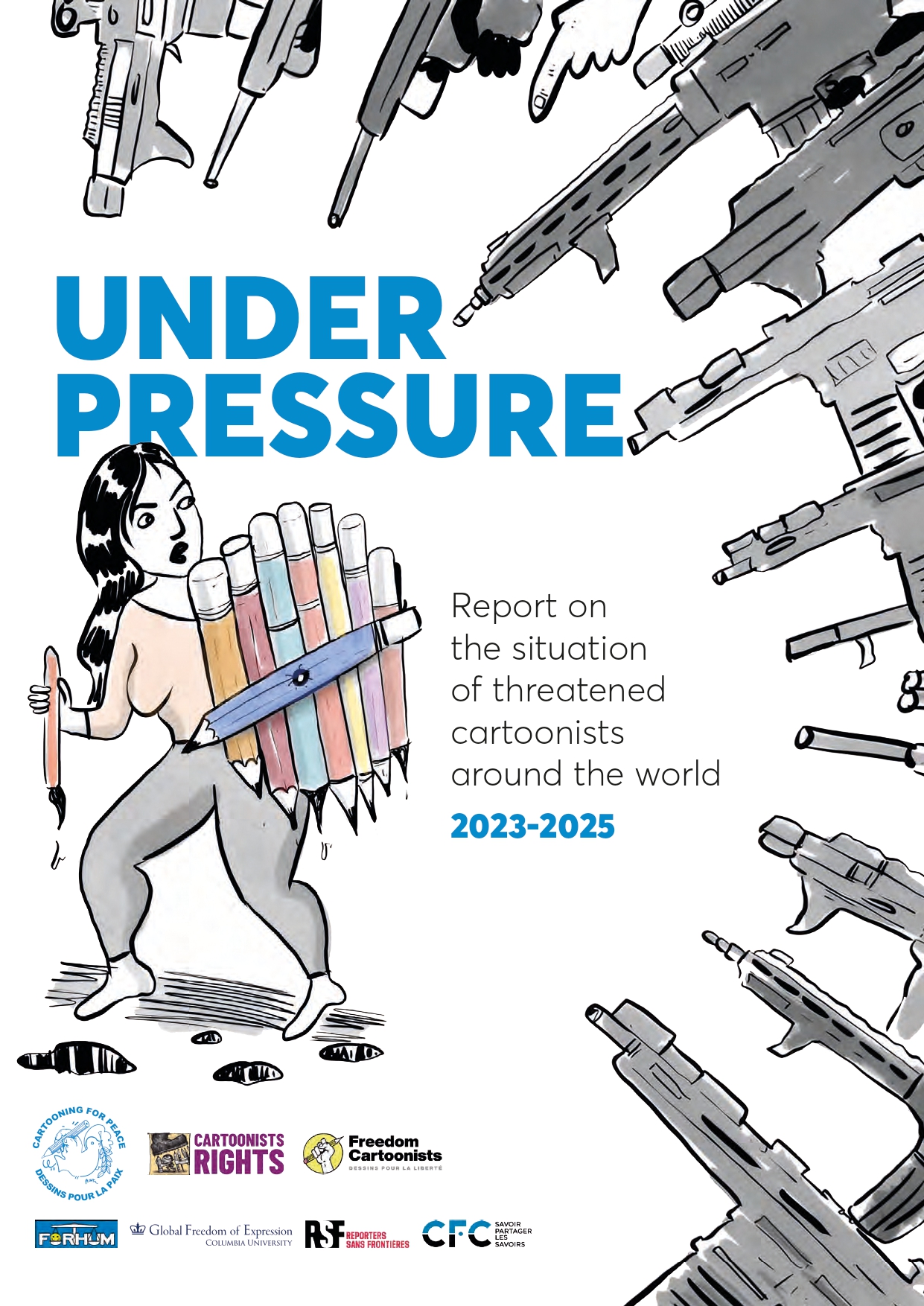
This year, the editorial cartoons curated by ESF are drawn from the report “Under Pressure,” on the situation of threatened cartoonists worldwilde (2023–2025), produced by Cartooning for Peace and Cartoonists Rights in partnership with the Freedom Cartoonists Foundation, Forhum, Columbia Global Freedom of Expression – Columbia University, and Reporters Without Borders.
This report outlines trends in threats against press cartoonists. Against a backdrop of rising authoritarianism, the cases of threats identified by Cartooning for Peace cast a stark light on the state of democracy around the world.
Download the report on the situation of threatened cartoonists worldwilde (2023-2025)
For the first time in the history of Reporters Without Borders’ World Press Freedom Index, more than half of the world’s countries are in a “difficult” or “very serious” situation.
Since 2005, RSF has published the World Press Freedom Index, which aims to compare the degree of freedom enjoyed by journalists and the media in 180 countries and territories.
Partners